Mesquite, Pine, and the Table in the Middle of the Room
The table in the middle of the week
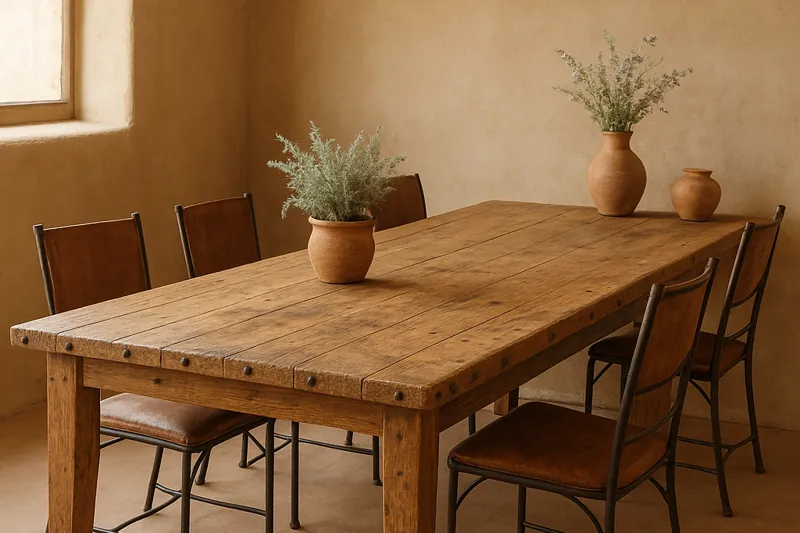
The math homework, the bills, the slow Tuesday dinner, it all lands on the dining table first. As Ethan Allen notes, in many homes, the dining table is the center of the world. You want a wooden table you don’t have to tiptoe around, what Peter Tischler calls furniture that people can be comfortable living with. Interior designer Karen Carpino describes Southwestern style as known for its relaxed, casual and rustic feel, with tables that are usually large and rectangular shaped. The material is often rustic pine in a distressed finish instead of clean lines, paired with wrought iron and leather accents, right down to the use of decorative nails.
Mesquite, alder, old pine, and two other oaks
When a table weighs as much as furniture built for ten, the wood matters. DeMejico works in three: mesquite, alder, and reclaimed old-growth pine. Mesquite is one of the hardest native woods, with grain ranging from honey gold to chocolate brown. Alder is lighter, with fine, even grain. Reclaimed pine, pulled from old haciendas, is denser than new growth and still shows nail holes and saw marks. Stickley’s quartersawn white oak can display tiger-stripe figure and vary in tone within a single board. Restoration Hardware’s Burnham uses solid reclaimed oak from decades-old Russian buildings, accented with nicks, knots, and imperfections. None of these woods behave the same over time. DeMejico advises asking which species, because alder, mesquite, reclaimed pine, and old-growth wood each have different weights, grain patterns, and long-term behavior.
Flat when it leaves the shop
A dead-flat top is a point of pride in one tradition and beside the point in another. Christian Becksvoort, in Fine Woodworking, writes that a well-made solid-wood table should leave the shop dead flat, but it will warp over time unless the maker follows basic rules for assembly, finishing, and restraint. Peter Tischler adds that the maker should use only well-seasoned stock and rough-mill in several sessions over two weeks to acclimate the wood. The top connects to its base with screws in slotted holes or cabinetmaker's buttons, so the wood can move without cracking.
The Burnham tear sheet takes the opposite view: salvaged planks may be somewhat uneven, and may cup or bow slightly over time, further enhancing their rustic one-of-a-kind character; cracks will be present. DeMejico’s rustic line uses wood hand-selected for natural irregularities, with knots left in and cracks stabilized and left visible. These sources disagree on what a table should promise.
A common mistake Becksvoort flags is finishing a table after the top is attached. That leaves unfinished wood under cleats and aprons. He also warns against gluing a cleat to the underside instead of screwing it; a glued cleat cannot let the top expand and contract, and the wood can crack.
The joint in the leg
DeMejico uses mortise and tenon joinery secured with wooden dowels, the wood itself does the locking, with no metal fasteners or pocket screws. Wrought iron bases are hand-forged in-house, and decorative clavos are hand-pounded. Pocket screws and cam locks are dismissed as production shortcuts.
On veneer, the makers part ways. DeMejico insists on solid wood plank tops. Ethan Allen offers elegant veneers like ribbon-striped sapele alongside solid oak or maple planks, using floating construction to allow wood movement. Top thickness varies: Peter Tischler recommends 1 to 1¼ inches, while Seth Keller’s Stickley reproduction uses 13/16-inch boards except for the feet.
Width, height, and how many chairs the numbers allow
Peter Tischler sets the most comfortable dining height at 28 to 28½ inches, a bit lower than what textbooks say. He advises a minimum width of 36 inches, warning that much over 40 inches loses intimacy across the table. DeMejico’s standard rectangular tables fall right into that zone at 36 to 40 inches wide, with lengths of 60 to 72 inches that seat six comfortably. Those numbers do not line up neatly with the ready-made options. A 72-inch Burnham table seats up to 8, and a 60-inch seats up to 6, but both stand 30 inches high, taller than Tischler’s comfortable range. Ethan Allen’s counts differ again: a 72-inch rectangular seats 6 to 8, a 60-inch seats 4 to 6, and a 96-inch seats 8 to 10, while the 96-inch Burnham seats up to 12. Round tables bring their own puzzle: Ethan Allen says both a 48-inch and a 60-inch round seat 4 to 6.
Stain, wax, and the questions to ask out loud
DeMejico hand-stains in multiple coats, sanding between each and sealing the surface, never painting over the grain. Their Colonial line uses lathe-turned legs and carved aprons. Ethan Allen distinguishes by touch: a smooth finish reads subtle; a rough-sawn top lets you feel every grain. Light neutrals feel airy; dark brown and black read formal. For the Burnham table, apply clear furniture wax for spills, use coasters, and avoid mineral oil, which can discolor reclaimed oak.
Before buying, ask DeMejico’s four questions: Is the top solid plank? What species? How are the joints made? Is the iron hand-forged or cast? Then lift the table, proper weight signals honest materials. Do that at their 30,000-square-foot Valencia showroom.