Pine Chests, Ranch Poles, and Texas Cabinets
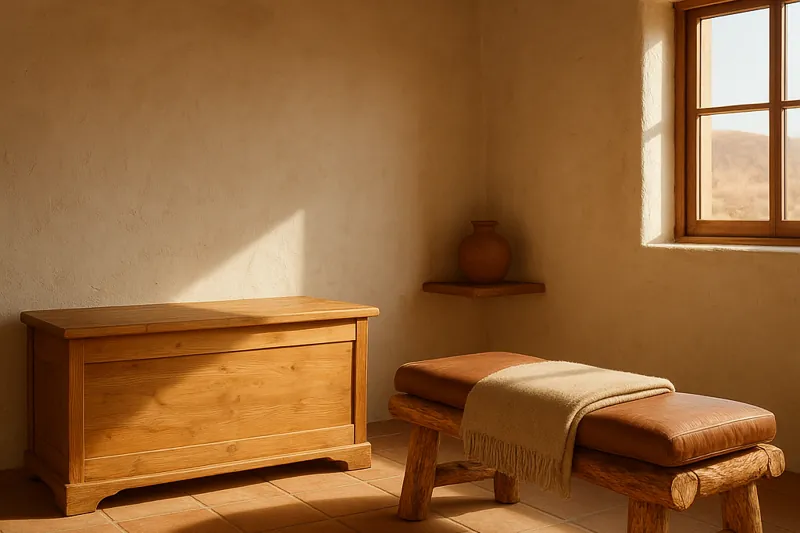
Abandoned bureaus, and a search that still lumps them
The Oregon Trail was littered with what settlers could not carry: fancy bureaus, pianos, and the heavy furniture they had hoped to haul west. Western pioneers who pressed on built their own simple pieces from materials at hand, leaving those discarded cases behind them in the ruts.
Today, those separate stories tend to travel under one "Southwestern" label. A Rio Grande piece built in New Mexico, a Cody boot cabinet made from peeled poles, and a Hill Country cabinetmaker's work can end up described the same way. A common mistake is buying or arranging them as one style, as if the trail had flattened every tradition into a single look.
There are at least three separate lineages worth sorting out: the New Mexican forms that developed along the Rio Grande, the Cowboy Style shaped by figures like Thomas Molesworth, and the mid-nineteenth-century trade documented in Texas. Sven Hanson, writing in Fine Woodworking, is careful to call the New Mexican work a distinct Rio Grande style, not a generic Southwestern one.
Ponderosa, dovetails, and six New Mexican forms
The furniture that took shape along the Rio Grande was built for a different rhythm of life. Early Spanish makers worked with native ponderosa pine, a softwood that demanded bigger dimensions and through-mortising if a piece was to survive daily use. Exposed dovetails and through-tenons were the common joinery, with tenons usually cut under-width so they could be wedged at the ends. You can still spot this construction in surviving pieces, the mechanical logic left visible rather than hidden.
Sven Hanson's account identifies six main forms: the chest, cupboard, shelf, chair, bench, and table. The caja was the most universal piece, serving as luggage, storage, seating, and a surface for carved declaration. Rosettes, crosses, lightning bolts, and bullets decorated the faces, with those corner dovetails doubling as ornament. The trastero stood about as tall as its owner and roughly half that in width. The repisa, a wall-mounted shelf for plates or books, Hanson calls the folksiest member of the group. Armless sillas were scaled to a smaller frame, with a seat depth that might be as little as 13 inches. The banco resembles a wide armchair with a slab seat, no cushion, and an odd count of spindles along the back and below the front rail. Tables were an afterthought, mesas rarely used for seated dining; museum examples often carry aprons and stretchers that would block a chair from sliding underneath.
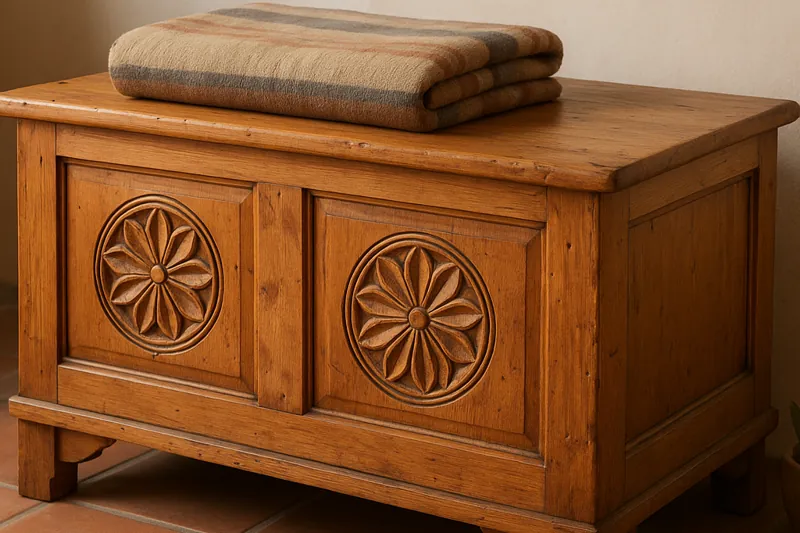
Under Mission influence, pieces grew heavier still, with exaggerated projecting tenons in what became known as Taos furniture. Later, a style Hanson names Pueblo Deco combined what Hanson describes as Native American and Art Deco designs with deeper carving and bright paints. That movement, not the early colonial work, is what most shapes New Mexican furniture today.
Where the New Mexican record disagrees
If you are trying to date or judge an old New Mexican piece, it helps to know that historians do not agree on how much furniture early households had. Richard E. Ahlborn, then Chairman of the Department of Cultural History at the Smithsonian Institution, wrote that furniture for all but several wealthy families was almost non-existent before 1800 in the Spanish Southwest. In the fashion of Moorish southern Spain, most people sat, worked, ate, and slept on floors, protected only by a few rough textiles. Three-legged stools, six-plank chests, perhaps another of leather, hanging shelves, built-in cupboards, and low tables appeared before tables, chairs, and free-standing cupboards became common. Furniture was crafted from local pines and cedar, then worked with chisel, gouge, foot-lathe, and plane.
Elizabeth A. Fleming challenges this scarcity view. She rejects the misconception that a mentality of making do with available materials prevailed on the Spanish colonial frontier, arguing that this view comes from equating the New Mexican experience with that of European colonists in New England. She also disputes the belief that Hispanics immediately and methodically dislocated and annihilated the Native American population. The 1790 census of Albuquerque records that 69 percent of marriages were between different racial groups. The Franciscans, she notes, trained Pueblo people in textile weaving and woodworking.
Meanwhile, Western Art & Architecture's account has Spanish Colonialists traveling up the Camino Real in the 16th century, bringing furniture makers who worked the region's pine, which the article calls honey pine, uneasily beside Ahlborn's claim of almost no furniture before 1800.
On color, Robin Farwell Gavin says Spanish Colonial pieces are most often raw wood with occasional chip or bullet carving and very little paint. Yet she also says they did paint these pieces in bright colors with water-soluble paints that wore off over time. The museum houses a late 18th-century pine chest with six-board dovetail joinery and traces of pigment.
Sven Hanson adds that colonists often used beeswax. Put that beside Gavin's water-soluble paints that wore off, and a piece that reads as plain wood today may once have carried color.
Winter work in Cody
Rustic, in the Center of the West's reckoning, means furniture that brings nature indoors with little alteration, twists and turns of wood left as found, bark still clinging, antler and horn and leather finding their place. The term also carries an assumption: the maker worked without formal training. That is one lineage, the ranch hand pressed into winter work, building from logs and branches, twigs, leather, bone, and fur through the long, cold winters.
Thomas Molesworth complicates the story. He had studied at the Art Institute of Chicago in 1908–1909, and his influences ran through the Arts and Crafts Movement there and the Adirondack style. The Center of the West places his move to Cody and the opening of the Shoshone Furniture Company in 1931; Western Art & Architecture says he moved to Cody in 1933. By the Center's account, his business took off in 1933, when Moses Annenberg commissioned him to furnish a 10,000-square-foot Wyoming ranch retreat, nearly 250 pieces. The dates stand unreconciled.
This Cowboy Style is not the pine trastero tradition. Ken Siggins, a third-generation rancher on the Double L Bar Ranch along the South Fork of the Shoshone River, builds in that same Cody lineage, fellow craftsmen calling him the bridge between Molesworth and today. For one boot cabinet, he begins with Douglas fir poles that must age, dry, be treated for insects, and peeled before they become uprights. The Center of the West followed that one cabinet step by step, from raw fir pole to finished piece.
Nine hundred Texas cabinetmakers
A third lineage sits on the shelf in plain sight. Texas Furniture, Volume One: The Cabinetmakers and Their Work, 1840–1880, by Lonn Taylor and David B. Warren with an introduction by Ima Hogg, has been the authoritative reference on this subject since its first appearance in 1975. The revised edition, a 392-page volume from University of Texas Press priced at $60.00, records what the authors found after more than a decade examining pieces held by museums and private collectors across the state. Their catalog presents more than two hundred pieces, each entry naming its maker, date, materials, measurements, history, and owner.
The book gives particular weight to the German immigrant cabinetmakers of the Hill Country and Central Texas, and its index holds biographical entries on approximately nine hundred men who made furniture in Texas during those decades. The publisher's description does not name particular woods or joints, so for those details you will need the book itself. The book documents the tools and techniques; it does not hand us a ready style.
A price is not an appraisal
Railroads arrived in New Mexico in the 1880s, bringing Victorian furniture and displacing Spanish Colonial forms. Interest revived by the 1920s and through the WPA of the 1930s–40s, putting Hispano craftsmen back to work. That 2010 article names Tomas C'deBaca among them, with his son David continuing in Santa Fe. Dealer Murdoch Finlayson notes that early pieces carry rare soul, WPA examples surface more readily, and Santa Fe galleries or private dealers can help.
Terry Winchell of Fighting Bear Antiques, also in that article, reported selling one Molesworth desk suite for $70,000 and said Molesworth sideboards can bring up to a couple hundred thousand dollars. He credited Molesworth with creating a Cody industry comprising 10–15 percent of the town's economy.
Before buying pieces sold as Molesworth or early Spanish Colonial, call a certified appraiser.