Picture Windows, Mud Plaster, and a Living Room Without a Theme
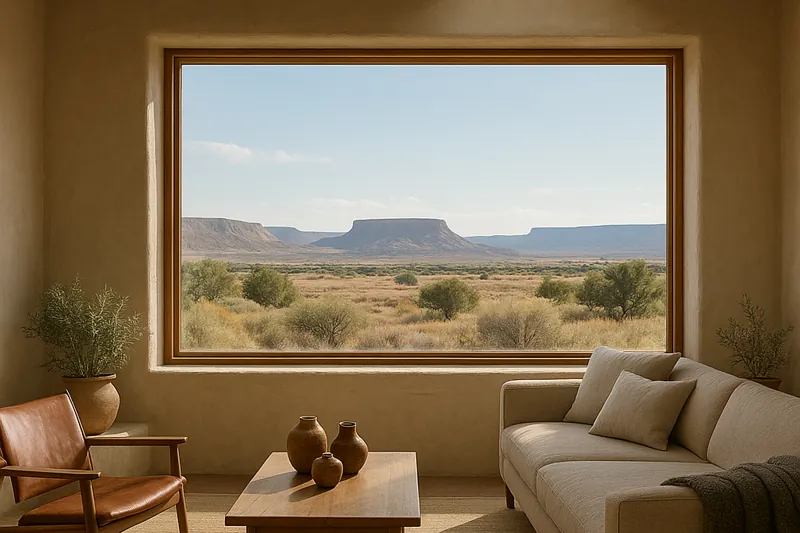
The sitting room in the Korab photograph
If you want a Southwestern living room that feels lived in rather than themed, start with a room that never leaned on a theme. Balthazar Korab’s photograph Abiquiu House, Sitting Room, Circa 1965 shows Georgia O’Keeffe’s home as an unlikely mid-century-modern masterpiece that kept its original adobe bones. She retained the traditional plaster treatments while opening the space with large picture windows, skylights, and an open-concept layout. The furnishings were modern, the room a place to experiment with color, pattern, and texture, far from the design capitals where she had connections with furniture and textile designers. O’Keeffe lived in that house from 1949 to 1984, and the same exhibition that holds Korab’s photograph also includes her Marimekko “Varjo” dress from around 1963, designed by Annika Rimala. The museum calls the house an artist’s sanctuary, made to foster inspiration and contemplation; it was never a formula.
Santa Fe Style was a building plan
The look we now call Santa Fe Style began not with a shopping list but with a building plan. The model was the mission churches of Acoma and Isleta, and the sculpted adobe masses of Taos Pueblo. Early examples by the firm of Rapp and Rapp, the New Mexico Museum of Art and the La Fonda Hotel, set the pattern with Spanish colonial details: carved and painted vigas, herringbone latillas, and hand-carved furniture. Those buildings defined what became known as Pueblo Spanish Revival. John Gaw Meem was the first New Mexican architect to develop the style fully. He designed curves and battered walls that echoed ancient buildings and the surrounding landscape, convinced that the ancient shapes of Pueblo buildings were functional and therefore modern, and could be combined with modernist ideas and materials.
What we’d skip: bringing home a Thunderbird Mirror like Robert Woodman’s circa‑1945 tin‑and‑glass piece, or borrowing the motif ornament from Albuquerque’s Kimo Theater. Mary Colter, the interior designer for the Fred Harvey Company, brought Native American designs, symbols, weavings, and traditional artworks into its hotels and train stations; that was a company’s commercial program, not a living‑room formula. The architecture was always about a structure’s relationship to place, not a set of decorative souvenirs.
Ponderosa, fir, clay, and iron
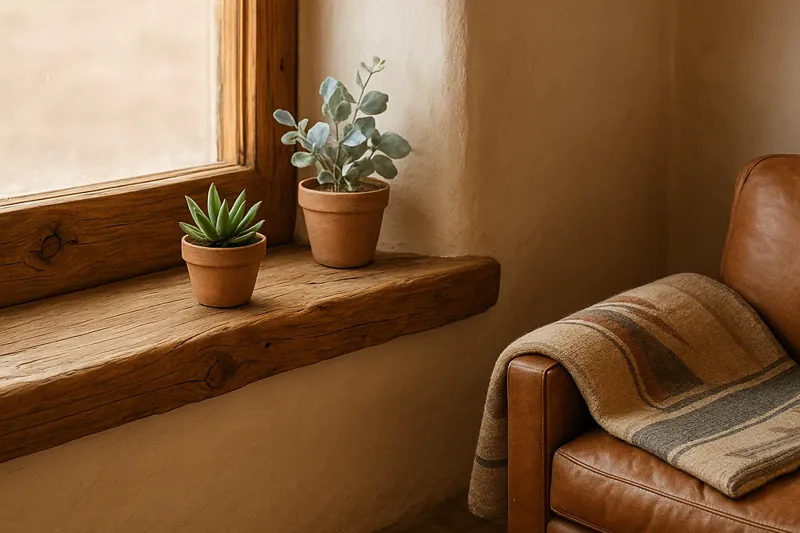
In Susan Stella’s 900‑square‑foot Tesuque adobe, hand‑built in the 1970s, the texture starts at the windows. She added 3‑inch‑thick window sills of ponderosa pine that, as she told Mountain Living, “feel very Old World New Mexico,” and coated the walls in a soft white clay paint, saving American Clay earth plaster in warm rose and adobe brown for the bed walls. The brick floors are original.
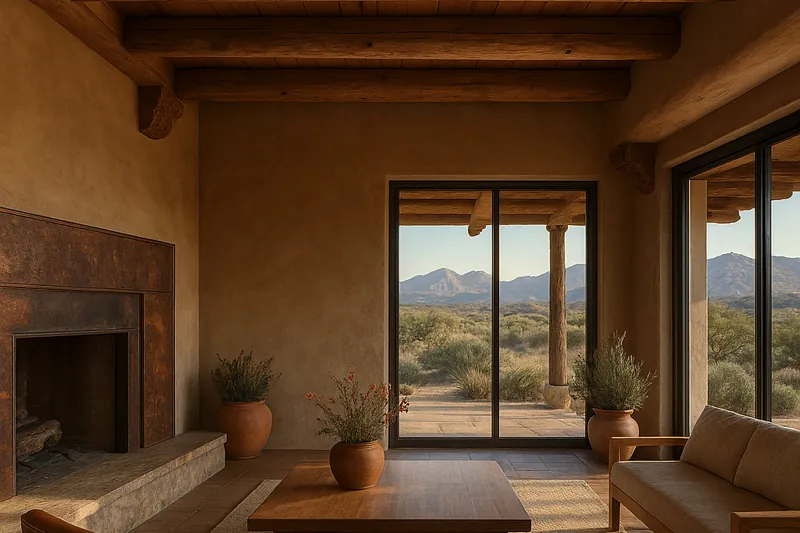
In Placitas, the Barattinos’ great room works at a larger scale. Massive fir beams and 30‑inch custom corbels span the ceiling, while a fireplace surround of hammered iron and copper, designed by the homeowners, sits against a natural clay‑plastered wall. Builder Kay Beason and architect Jim Clark tweaked the orientation by a few degrees to frame the mountain views through glass sliding doors. If your own room calls for new plaster, beams, corbels, or a fireplace surround, hire a contractor; structural changes or shifting a room’s orientation mean an architect.
Craft beside the adobe, without the clichés
In gallerist Christopher Webster’s Santa Fe living room, a 19th‑century Navajo rug anchors the space beneath layered, hand‑applied mud plaster finished in the manner of an old hacienda that changed over hundreds of years. Vintage Knoll pieces sit alongside antique Spanish and Mexican works because Webster’s throughline is “quality, craftsmanship, and attention to detail.” His collecting advice is simple: buy what you like, art you respond to rather than what someone else calls important. Elsewhere in Santa Fe, the Ingham Mullally living room is meant to be suggestive of its surroundings without a single Southwestern cliché. Beneath 13‑foot ceilings and what the magazine calls “giant square wooden beams,” an enormous sofa in Rosemary Hallgarten mohair velvet and leather and a shaggy rug, both by Stahl + Band, and a painting by Antoine Chartres set a tone that makes you stop and gasp each time you walk past. If your own sofa will sit in strong desert sun, ask the upholsterer how the fabric holds up.
A limited palette, or the rug and the sunset
A limited palette shows up in houses of very different sizes. For her 900-square-foot Tesuque home, Susan Stella kept the colors tight: “select a limited color palette and rely on textures and patterns to add depth and interest.” She was after a tactile, solid feel in materials, simple, minimal, but real. The Ingham Mullally living room follows a similar restraint, its palette carefully limited to ginger and rust against pale walls, with slashes of black and brown and plenty of geometric pattern.
Designer Karla Tewes took the opposite approach in a 4,200-square-foot adobe on a hill outside Santa Fe, where the clients’ Persian carpets drove a wider range of reds, browns, and blues. “The one consistent thread in their homes is that they love color,” she says, and the desert landscape was a huge source of inspiration too: “the term ‘purple mountain’s majesty’ there, not to mention the multicolored sunsets.” The challenge was integrating East Coast furniture into a Southwestern setting, and she met it by carrying those rug colors through the house while installing very few recessed lights and relying on natural light, sconces, table lamps, and floor lamps. Stella’s restraint suits a small adobe; Tewes’s color suits a big house built around a collection of rugs.
A practical next step: the free exhibition “Artful Living: O’Keeffe & Modern Design” runs at the O’Keeffe Welcome Center in Abiquiú through January 30, 2027, and its free digital guide is available online in English and Spanish.