Plants That Hold a Desert Patio Through the Dry Summer
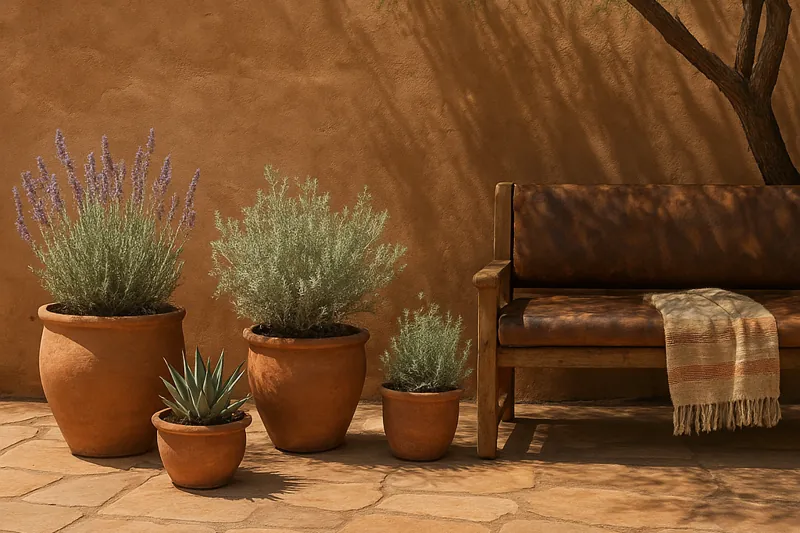
The patio in dry summer
Picture a patio on a Dry Summer afternoon, the paving throwing heat back at every pot, and a plant tag that promises "full sun." The University of Arizona Cooperative Extension garden design guide compiled for the 2024 Master Gardener home Garden Tour separates sun exposure into full sun and reflected heat, partial shade, and shade, and it warns plainly that "'Full Sun' for a plant grown in coastal CA is probably more like 'Morning/Partial Sun' here." That here is Tucson, where the Pima Smartscape HOA slide deck records average annual rainfall at 11 to 12 inches. The same Extension guide marks five seasons for the Low Sonoran Desert: Winter, Spring, Dry Summer, Wet Summer/Monsoon, and Fall. A plant hardened to that narrow band between dryness and the monsoon that follows, and chosen from stock grown at a local, established nursery, has a better chance of thriving than one shipped in from another state.
Grown size, not the pot you brought home
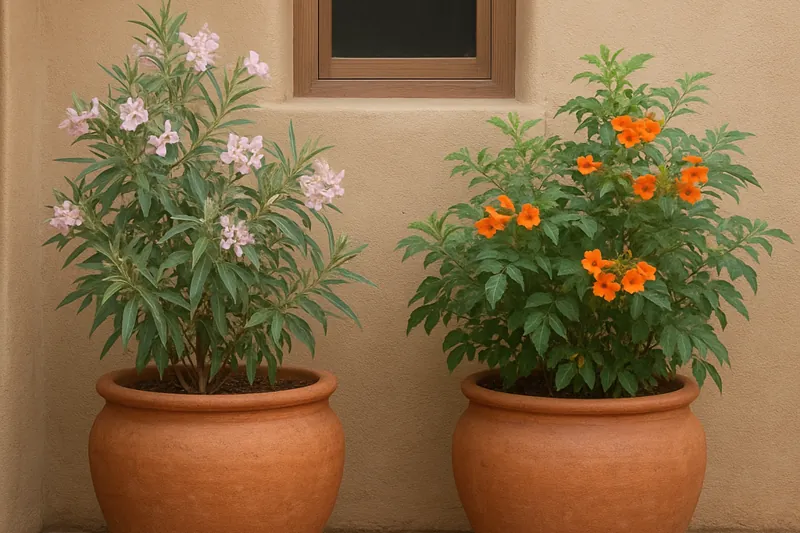
The plant you carry home from the nursery is a fraction of its grown size, and a patio has little room to spare. The University of Arizona Cooperative Extension garden design guide spaces trees and shrubs by mature width, not arrival size, and reminds readers to allow clearance under windows and beside doors, gates, walkways, and driveways. Annuals can fill gaps until foundation plants mature, though the Pima Smartscape HOA slide deck treats bloomers as high-maintenance, one-cycle plantings, not structural summer patio plants. Where container success is documented, the Garden Design desert plants guide names two: El Niño Desert Orchid, a chitalpa hybrid reaching four to six feet wide with fragrant pink summer flowers, and Chicklet Orange esperanza, a compact tecoma hybrid two to four feet wide with orange trumpet-shaped blooms.
Desert Museum, and the lists that do not agree
The Wynn Anderson publication for the El Paso and Las Cruces area marks Desert Museum Palo Verde, Parkinsonia x Cercidium hybrid, for "Flowers, patio," with availability code 1. Desert Willow, Chilopsis linearis, carries the same code and is noted for "Flowers, xeric," but not patio use.
The Lake Havasu City Recommended Landscaping Plant List flips both calls: it marks the thornless Desert Museum, 25 feet tall and wide, patio tree N, while Desert Willow, 25 feet tall and 20 feet wide, and the thorny Blue Palo Verde, Parkinsonia florida, 30 by 30 feet, are both patio tree Y.
The Pima Smartscape HOA slide deck offers a third arrangement, naming Desert Willow and Blue Palo Verde among native shade tree examples, while its patio tree example is Texas Mountain Laurel. So a tree can be a shade tree on one list and a patio tree on another. Whichever list you follow, check the tree's grown width against the space beside your patio before you plant.
Trees marked for a patio, with their width
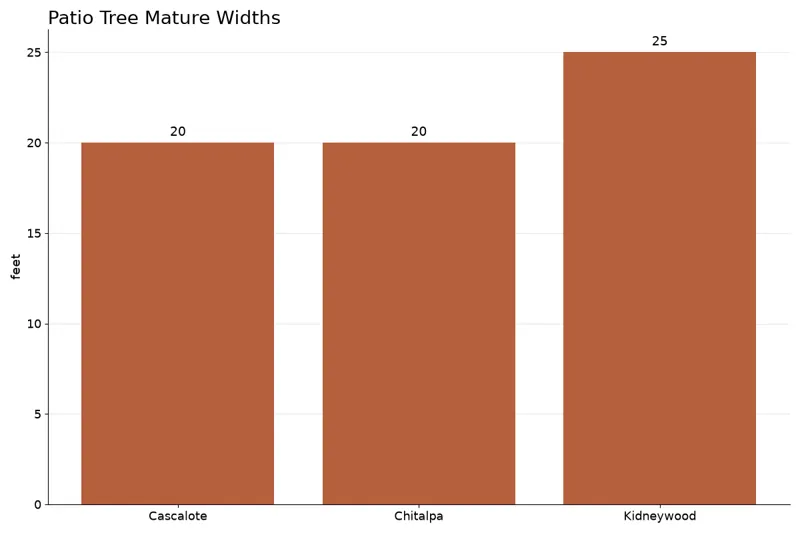
The Lake Havasu City Recommended Landscaping Plant List marks three trees for patio use at landscape size. Cascalote, Caesalpinia cacalaco, reaches 20 feet in height and width with thorns. Chitalpa, x Chitalpa tashkentensis, reaches the same 20 by 20 feet without thorns. Kidneywood, Eysenhardtia orthocarpa, spreads wider at 18 feet height and 25 feet width, semi-evergreen and also thornless.
The Wynn Anderson publication for the El Paso and Las Cruces area marks seven patio trees in all, including Chitalpa and Desert Museum Palo Verde. Three of the others: Anacacho Orchid Tree, Bauhinia lunarioides, carries availability code 1. Mexican Redbud, Cercis canadensis var. mexicana, holds the same code. Texas Persimmon, Diospyros texana, is noted specifically for patio use but carries code 2, meaning scarcer nursery stock.
Low plants at the edge of the paving
Along the edge of the paving, look for plants that stay low, carry no thorns, and leave the walkway clear at their grown spread. The Robin Kobaly High Desert brochure recommends three ground covers for desert patios: Damianita, cold hardy below 0°F; Trailing Indigo Bush, hardy to 15°F; and Prostrate Rosemary, hardy to 0°F.
The Pima Smartscape HOA slide deck groups Red bird of paradise and Autumn sage as large shrubs over 6 feet tall. That height conflicts with the Lake Havasu City Recommended Landscaping Plant List, which lists Autumn Sage at 2 feet height and 2 feet width.
The Garden Design desert plants guide notes pet toxicity for Mexican bird of paradise, an evergreen shrub or small tree 10 to 12 feet tall and 6 to 20 feet wide, with thorny foliage and summer-to-fall blooms in zones 9 to 11.
Water on a desert schedule, not a mulch blanket
When the University of Arizona Cooperative Extension groups plants by moisture needs, it ranges from Drought to Deluge, passive water harvesting to active irrigation, and Oasis zones to Native/Dry. The City of Phoenix Water Services Department desert landscape brochure offers a seasonal chart for established plants: every 14 days in summer, 22 in fall and spring, up to 37 in winter, with a half-inch rain allowing a week-plus delay. Yet that same brochure states mature desert plants need no irrigation. The brochure does not say whether the chart is meant for the years while plants establish, so treat it as a starting point and water less as plants mature.
The SummerTree Institute High Desert brochure adds another layer: Very Low Water Use plants survive without supplemental water once established; Low Water Use needs monthly summer water; Moderate needs twice monthly. These differ from Phoenix's chart.
The Phoenix brochure also places emitters at the canopy edge, not the trunk. It warns against blind mulch use: moisture-trapping layers suit thirsty plants but harm most desert plants.
Neither the Phoenix chart nor the SummerTree categories mentions containers, so check potted plants on the patio on their own schedule.
Cold air, and the list in your pocket
A plant that handles summer heat can still be damaged by winter cold. The SummerTree Institute High Desert brochure notes cold hardiness in degrees Fahrenheit for each entry, treating it as the limiting factor for many species. Summer highs may reach 115°F, yet higher elevations and slope bottoms can drop to 10°F or less. Plants that do well at lower elevations may suffer frost damage when planted higher up or at the bottom of a slope, where cold air settles. The brochure lists Texas Mountain Laurel at 0°F, Red Yucca at 5°F, Autumn Sage at 0°F, and Texas Ranger varieties at 10°F. It advises readers to take its printed list to a local nursery. The University of Arizona Cooperative Extension garden design guide and Pima Smartscape HOA slide deck point to additional resources, but the High Desert list is the one that pairs your winter low with the plant. Print that list and carry it.